Do Fountain Pens Offer Superior Nib Types, Ink Precision & Long-Term Writing Quality?
Do Fountain Pens Offer Superior Nib Types, Ink Precision & Long-Term Writing Quality?
Yes. The superiority of fountain pens is substantiated by rigorous engineering principles involving capillary hydrodynamics and advanced material science, relying on a coordinated system of four components: the Nib, Feed, Ink, and Body. This guide details how the “static regulation” of ink flow and specific alloy materials create a writing tool that operates without mechanical pressure.
Why is Understanding Technical Superiority Important?
Understanding the technical superiority of a fountain pen is critical because it directly impacts writing health (occupational hydrodynamics) and the aesthetic precision of the line. The difference between a ballpoint and a fountain pen is the difference between mechanical friction and controlled fluid physics.
Connection to Writing Health (Occupational Hydrodynamics)
The fundamental advantage of the fountain pen is the elimination of compressive pressure, requiring only 30 to 80 grams-force (g-f) to actuate the capillary flow. This is in stark contrast to the high pressure required to shear-thin the viscous ballpoint paste. High writing pressure is linked to Occupational Cervicobrachial Disorders (OCD) and muscle fatigue, making the fountain pen a superior ergonomic choice for sustained, high-volume writing.
Connection to Aesthetic Precision
The engineering of the nib allows for line variation and color depth that is physically impossible with mono-line ballpoints. Standard nibs range from 0.5 mm to 0.9 mm, while specialty cuts (Stub/Italic) reach 2.3 mm, offering architectural control over the script. Furthermore, the water-based ink penetrates paper fibers, creating “shading” (color intensity variation) and “sheen,” adding dimensionality to the writing.What is the Role of the Nib, the “Precision Sculptor”?
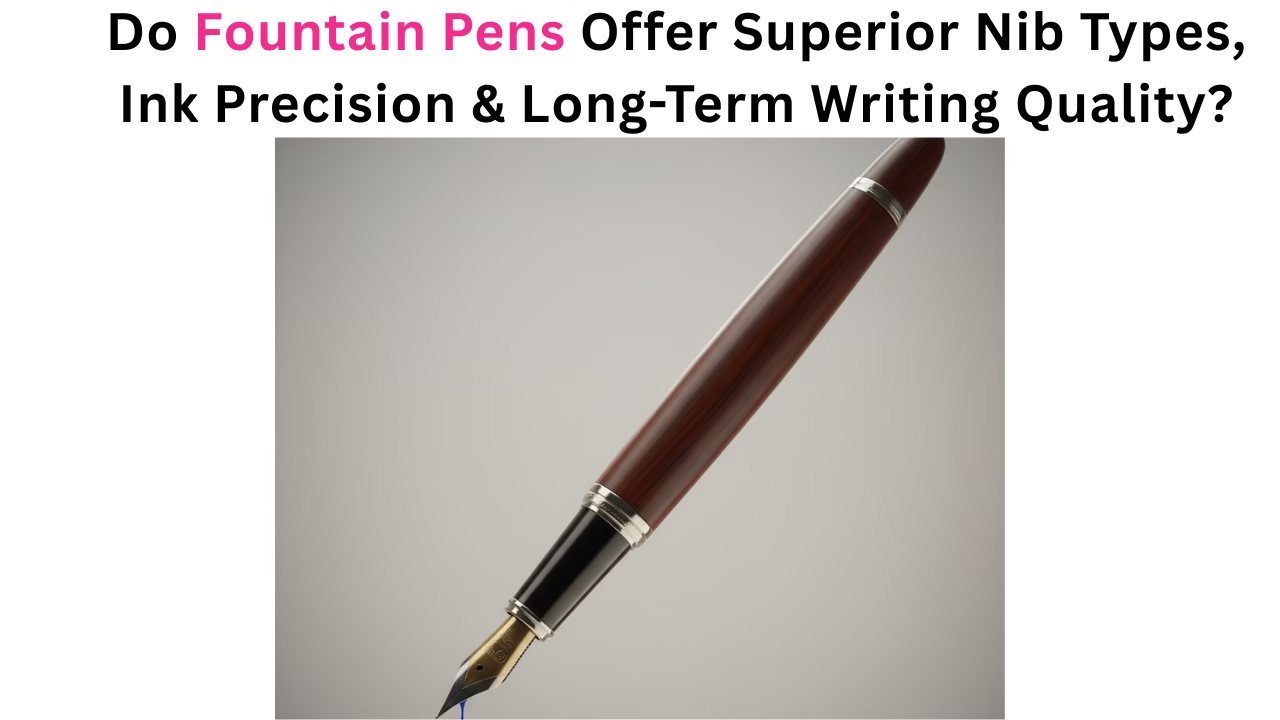
The Nib acts as the “Precision Sculptor,” a static contact point that shapes ink into letters using specific geometric cuts rather than a rolling ball. Unlike a ballpoint that relies on friction, the nib’s geometry (flex, italic, oblique) determines the line’s architecture. The nib functions entirely through surface contact and capillary action, requiring minimal downward force to initiate flow.
Material Science: The Tipping Alloys: While often called “Iridium,” the longevity of a modern nib comes from a hard metal alloy pellet fused to the tip, typically composed of Platinum Group Metals such as Osmium, Rhenium, Ruthenium, and Tungsten. These wear-resistant alloys allow a well-maintained nib to last 75 to 100 years, transforming the pen into an heirloom asset.
Hydrodynamic Regulation: Feed and Ink
The writing experience is governed by the hydrodynamic regulation between the Feed (the “Traffic Controller”) and the Ink (the “Liquid Medium”).
The Feed (The “Traffic Controller”): The Feed is a “Static Control System” that uses no moving parts, relying entirely on surface tension to regulate the exchange of liquid and air. It precisely balances internal pressure against atmospheric pressure, allowing ink to flow down through the micro-capillary channels while simultaneously letting air bubbles travel up to prevent a vacuum lock.
The Ink (The “Liquid Medium”): Fountain pen ink chemistry is dictated by the feed’s micro-capillary channels, requiring a solution that is 75% to 90% water with an ultra-low viscosity of $\le 2 \text{ mPa}\cdot\text{s}$. This contrasts sharply with ballpoint ink, which is a paste with viscosity between 25,000 and 120,000 cP. This massive difference is why ballpoints require pressure (to shear the paste) and fountain pens do not. To understand how different dyes interact with this system, read our guide on fountain pen ink chemistry.
Filling System and Barrel Roles
The Filling System acts as the “Fuel Tank” for economic efficiency, while the Barrel serves as the ergonomic “Chassis.”
The Filling System (The “Fuel Tank”): The economic advantage is significant; while cartridges cost approximately $0.80 – $1.00 per mL, bottled ink drawn via a piston/converter costs approximately $0.20 – $0.50 per mL. This system results in a long-term cost reduction of 40% to 80% and allows access to a far wider range of specialized colors.
The Barrel (The “Chassis”): The reusable chassis counters the “Buy-Use-Dispose” culture that generates 50 billion discarded plastic pens annually. Ergonomically, the barrel acts as a counterweight to the nib, stabilizing the hand for low-muscle-activity writing.
How Do Fountain Pens Compare to Ballpoints?
| Metric | Fountain Pen (Hydrodynamic) | Ballpoint Pen (Mechanical Friction) |
|---|---|---|
| Writing Pressure | 30 – 80 g-f (Zero Pressure) | High (Required for Shear-Thinning) |
| Ink Viscosity | $\le 2 \text{ mPa}\cdot\text{s}$ (Water-like) | 25,000 – 120,000 cP (Honey-like) |
| Tipping Material | Osmium/Ruthenium Alloy | Tungsten Carbide / Steel Ball |
| Cost Efficiency | $0.20 – $0.50 per mL | $0.80 – $1.00 per mL (equiv) |
| Lifespan | 75 – 100 Years | Disposable / Short-term |
Frequently Asked Questions
Historically yes, but modern fountain pen feeds are designed with “buffer fins” to capture excess ink expansion caused by air pressure changes; keeping the pen completely full or empty during takeoff further mitigates this risk by minimizing the air volume inside the reservoir.
Yes, left-handed writers can successfully use fountain pens by selecting “fast-drying” inks or finer nib widths to prevent smearing, and in some cases, utilizing specific “left-handed” nib grinds designed for “push” rather than “pull” writing angles.
Unlike disposable pens, a fountain pen requires a simple flush with water every 4-8 weeks (or when changing ink colors) to prevent dried particulate from clogging the capillary channels of the feed.
Key Takeaways of Fountain Pen Engineering
- Zero-Pressure Writing: Achieved through capillary action and ink with ultra-low viscosity ($\le 2 \text{ mPa}\cdot\text{s}$), reducing ergonomic strain.
- Material Permanence: Nibs tipped with Platinum Group Metals (Osmium, Rhenium) offer a 75+ year lifespan.
- Static Regulation: The feed acts as a hydrodynamic computer, balancing air and ink exchange without moving parts.
- Sustainability: The refillable system reduces plastic waste and lowers long-term ink costs by up to 80%.
Conclusion
In conclusion, the fountain pen is a sophisticated system where hydrodynamic principles and material science converge to eliminate the physical labor of writing. The precise cooperation between the Nib, the Feed’s static regulation of flow, and the ultra-low viscosity ink transforms writing from a friction-based chore into a sustainable, precision-based practice that protects user health and the environment.